3D VISION · KAIST

Honggyu An

Integrated M.S./Ph.D. student

I am an integrated M.S./Ph.D. student at KAIST, advised by Prof. Seungryong Kim . My research focuses on 3D/4D reconstruction and scene understanding , novel-view synthesis, depth estimation, and visual correspondence.

I collaborate with Takuya Narihira, Kazumi Fukuda, and Yuki Mitsufuji at Sony AI. I am also a research intern at Sony Group Corporation in Tokyo (September–December 2026).

Honggyu An
Honggyu An

Publications

* Equal contribution · † Equal advising

Conference & workshop papers

2027

Overview of RAIN-GS: Relaxing Accurate Initialization Constraint for 3D Gaussian Splatting
WACV 2027 · ECCVW 2026

RAIN-GS: Relaxing Accurate Initialization Constraint for 3D Gaussian Splatting

Jaewoo Jung * , Jisang Han * , Honggyu An * , Jiwon Kang * , Seonghoon Park * , Seungryong Kim

Abstract / summary

3D Gaussian splatting (3DGS) has recently demonstrated impressive capabilities in real-time novel view synthesis and 3D reconstruction. However, 3DGS heavily depends on the accurate initialization derived from Structure-from-Motion (SfM) methods. When trained with randomly initialized point clouds, 3DGS often fails to maintain its ability to produce high-quality images, undergoing large performance drops of 4-5 dB in PSNR in general. Through extensive analysis of SfM initialization in the frequency domain and analysis of a 1D regression task with multiple 1D Gaussians, we propose a novel optimization strategy dubbed RAIN-GS (Relaxing Accurate INitialization Constraint for 3D Gaussian Splatting) that successfully trains 3D Gaussians from randomly initialized point clouds. We show the effectiveness of our strategy through quantitative and qualitative comparisons on standard datasets, largely improving the performance in all settings.
2026

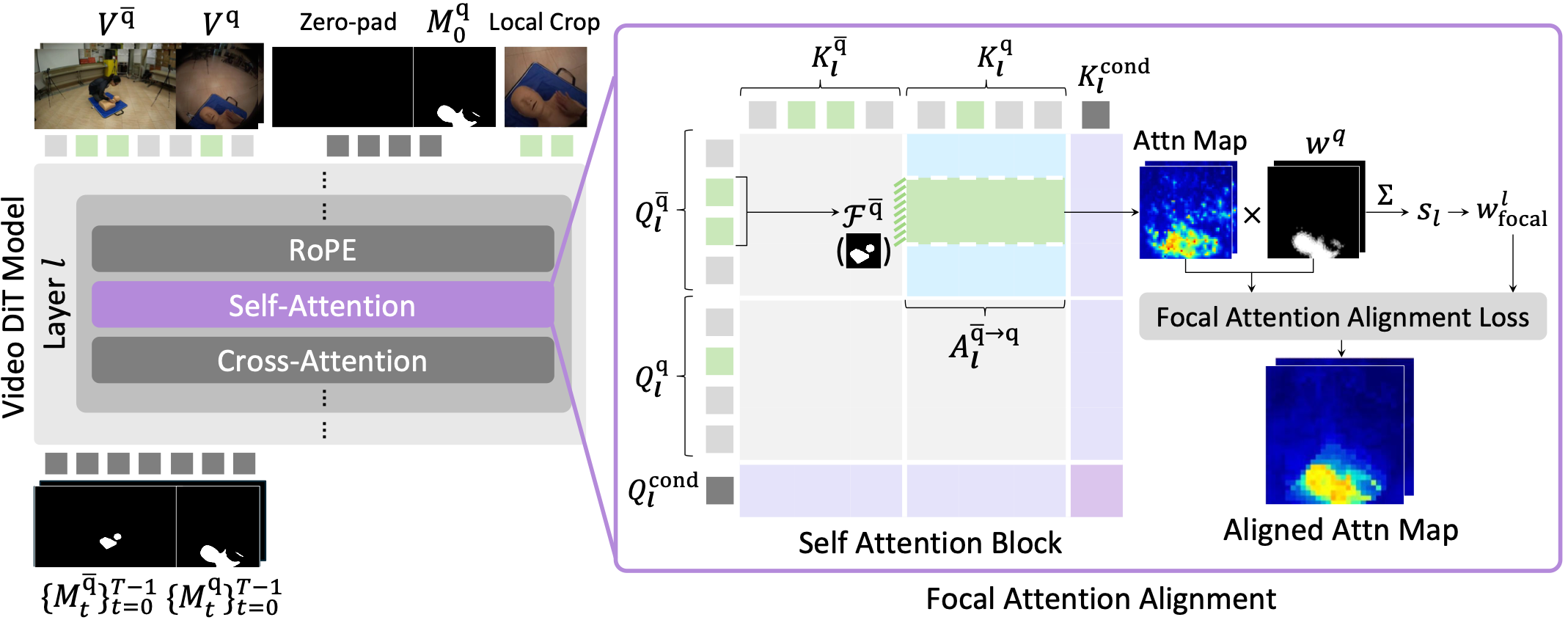
Overview of Repurposing Video Diffusion Transformers for Cross-View Spatiotemporal Object Correspondence
NeurIPS 2026

Repurposing Video Diffusion Transformers for Cross-View Spatiotemporal Object Correspondence

Siyoon Jin * , Dahyun Chung * , Honggyu An , Sangbeom Lim, Wonjin Nam, Jaewoo Jung, Wonjun Moon, Seungryong Kim †

TL;DR

XTrack repurposes a pretrained video diffusion transformer to track the same object across views and time from a single query mask. Targeted cross-view grounding strategies and dense pseudo-label supervision help preserve object identity under appearance changes and occlusions.

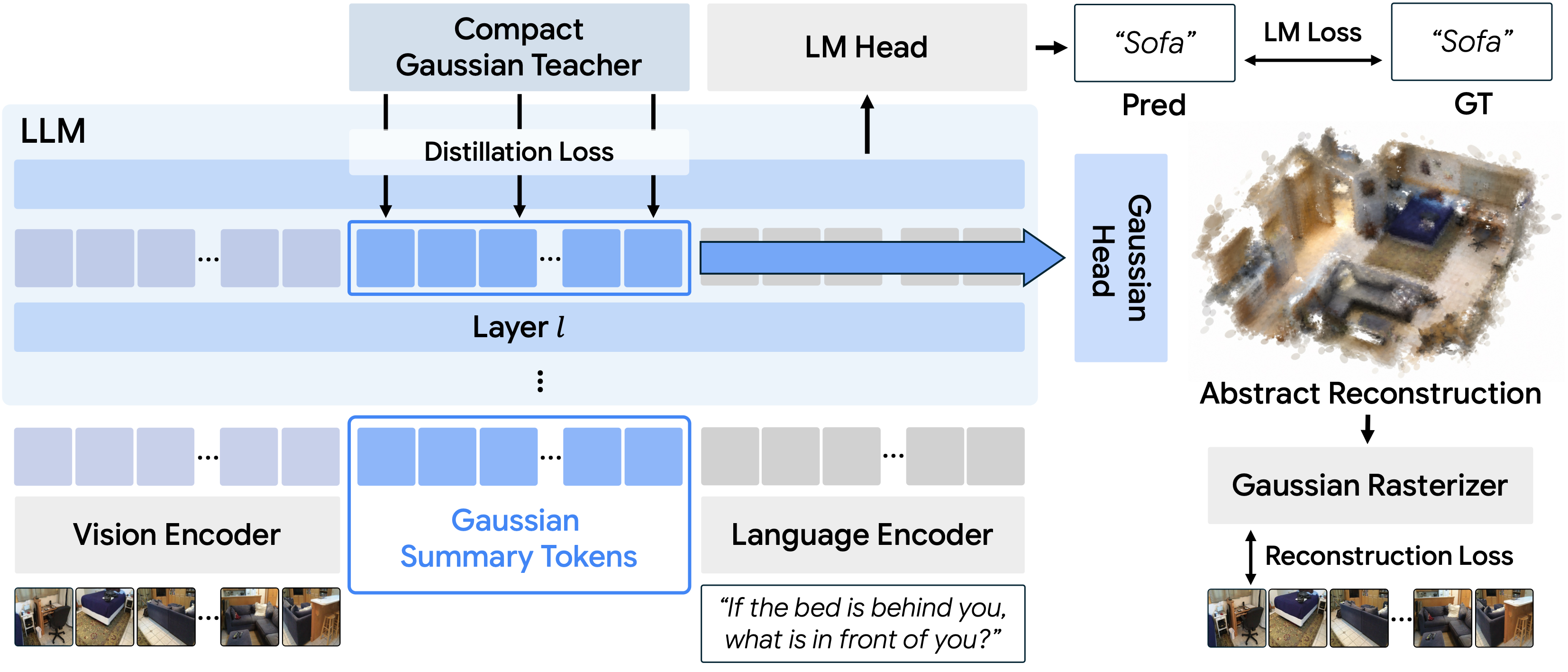
Overview of Imagine3D-LLM: Teaching MLLMs to Imagine 3D Scenes Before Answering
NeurIPS 2026 · ECCVW 2026

Imagine3D-LLM: Teaching MLLMs to Imagine 3D Scenes Before Answering

Jaewoo Jung, Hyunseo Yu, Honggyu An , Jisang Han, Mungyeom Kim, Minkyeong Jeon, Heeseong Shin, Wonjun Moon, Federico Tombari, Daniel Barath, Marc Pollefeys † , Seungryong Kim † , Sunghwan Hong †

TL;DR

Imagine3D-LLM teaches a multimodal LLM to build a compact 3D representation within its hidden states, helping it understand the scene’s 3D structure before answering questions.

Overview of TrackCraft3R: Video Diffusion Model for 3D Tracking
NeurIPS 2026

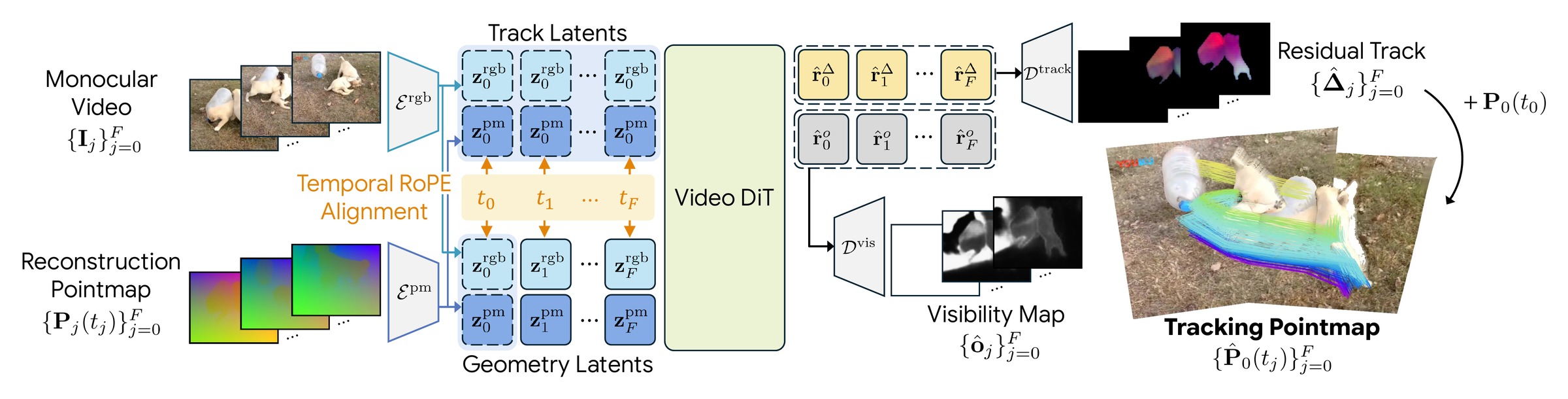
TrackCraft3R: Video Diffusion Model for 3D Tracking

Jisu Nam, Jahyuk Koo, Soowon Son, Jaewoo Jung, Honggyu An , Junhwa Hur † , Seungryong Kim †

Abstract / summary

TrackCraft3R is the first method that repurposes a video diffusion transformer as a feed-forward dense 3D tracker.

Overview of C3G: Learning Compact 3D Representations with 2K Gaussians
CVPR 2026

C3G: Learning Compact 3D Representations with 2K Gaussians

Honggyu An * , Jaewoo Jung * , Mungyeom Kim, Sunghwan Hong, Chaehyun Kim, Kazumi Fukuda, Minkyeong Jeon, Jisang Han, Takuya Narihira, Hyuna Ko, Junsu Kim, Yuki Mitsufuji † , Seungryong Kim †

Abstract / summary

We propose a feed-forward framework for learning compact 3D representations from unposed images. Our approach estimates only 2K Gaussians that allocated in meaningful regions to enable generalizable scene reconstruction and understanding.

Overview of Emergent Outlier View Rejection in Visual Geometry Grounded Transformers
CVPR 2026

Emergent Outlier View Rejection in Visual Geometry Grounded Transformers

Jisang Han, Sunghwan Hong, Jaewoo Jung, Wooseok Jang, Honggyu An , Qianqian Wang, Seungryong Kim, Chen Feng

Abstract / summary

We reveal that Visual Geometry Grounded Transformers (VGGT) has a built-in ability to detect outliers, which we leverage to perform outlier-view rejection without any fine-tuning.

Overview of Geometric Action Model for Robot Policy Learning
ECCVW 2026

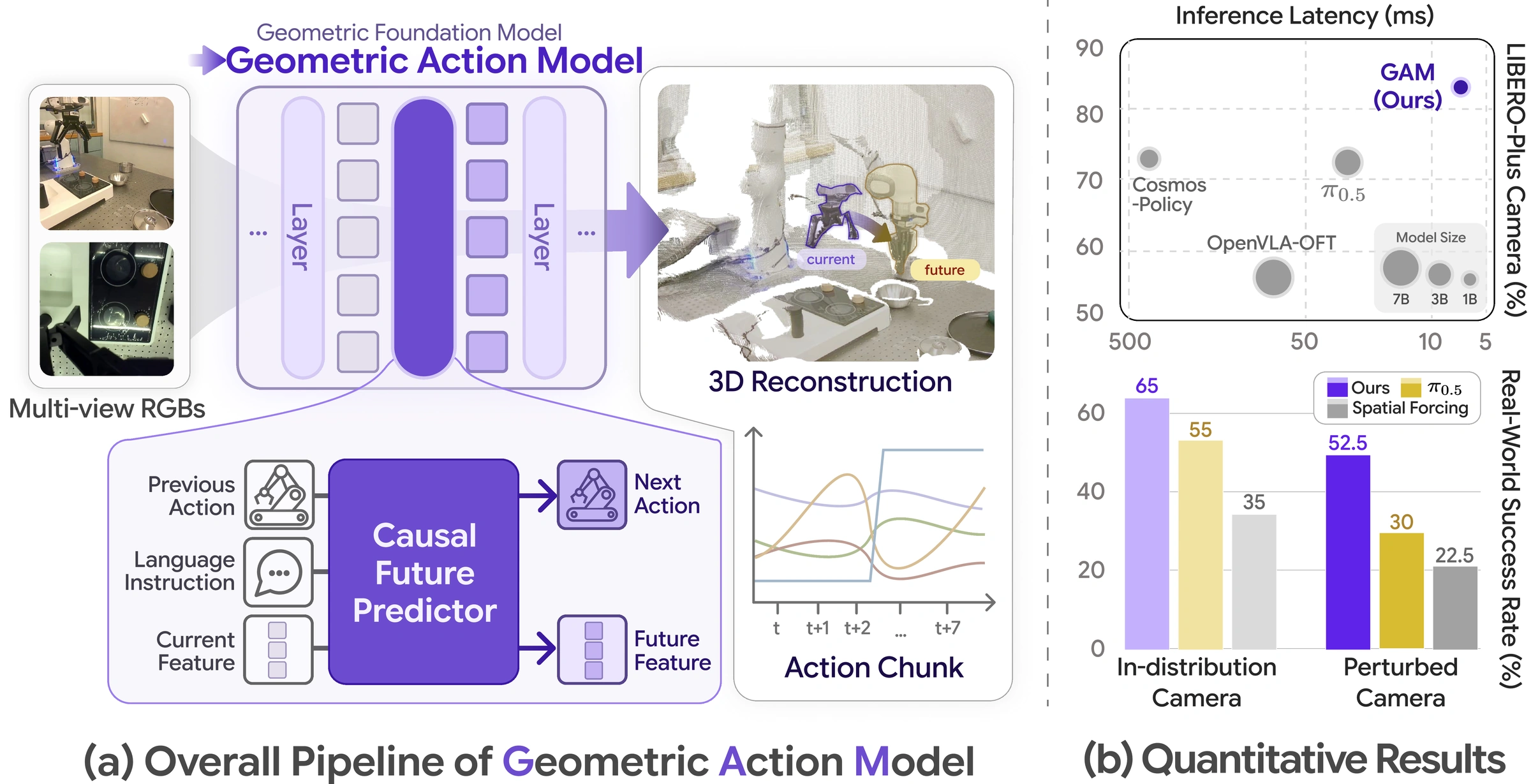
Geometric Action Model for Robot Policy Learning

Jisang Han * , Seonghu Jeon * , Jaewoo Jung, Rene Zurbrugg, Honggyu An , Tiffany Portela, Marco Hutter, Marc Pollefeys, Seungryong Kim, Sunghwan Hong †

Abstract / summary

A language-conditioned manipulation policy that repurposes a pretrained geometric foundation model as one shared backbone for perception, future prediction, and action; more accurate, more robust, faster, and lighter than foundation-model-scale baselines.

Overview of VIRAL: Visual Representation Alignment for Multimodal Large Language Models
ICLRW 2026

VIRAL: Visual Representation Alignment for Multimodal Large Language Models

Heeji Yoon * , Jaewoo Jung * , Junwan Kim * , Hyungyu Choi, Heeseong Shin, Sangbeom Lim, Honggyu An , Chaehyun Kim, Jisang Han, Donghyun Kim, Chanho Eom, Sunghwan Hong, Seungryong Kim

Abstract / summary

VIRAL directly aligns MLLM's visual tokens with pretrained vision model features, preserving fine-grained visual details and boosting vision-centric reasoning beyond text-only supervision.

2025

Overview of D²USt3R: Enhancing 3D Reconstruction with 4D Pointmaps for Dynamic Scenes
NeurIPS 2025

D²USt3R: Enhancing 3D Reconstruction with 4D Pointmaps for Dynamic Scenes

Jisang Han * , Honggyu An * , Jaewoo Jung * , Takuya Narihira, Junyoung Seo, Kazumi Fukuda, Chaehyun Kim, Sunghwan Hong, Yuki Mitsufuji, Seungryong Kim

Abstract / summary

We address the task of 3D reconstruction in dynamic scenes, where object motions degrade the quality of 3D pointmap regression methods, such as DUSt3R, originally designed for static 3D scene reconstruction. Although these methods provide an elegant and powerful solution in static settings, they struggle in the presence of dynamic motions that disrupt alignment based solely on camera poses. To overcome this, we propose D2USt3R that regresses 4D pointmaps that simultaneiously capture both static and dynamic 3D scene geometry in a feed-forward manner. By explicitly incorporating both spatial and temporal aspects, our approach successfully encapsulates spatio-temporal dense correspondence to the proposed 4D poitnmaps, enhancing performance of downstream tasks. Extensive experimental evaluations demonstrate that our proposed approach consistently achieves superior reconstruction performance across various datasets featuring complex motions.

Overview of Cross-View Completion Models are Zero-shot Correspondence Estimators
CVPR 2025 Highlight

Cross-View Completion Models are Zero-shot Correspondence Estimators

Honggyu An * , Jinhyeon Kim * , Seonghoon Park, Jaewoo Jung, Jisang Han, Sunghwan Hong, Seungryong Kim

Abstract / summary

In this work, we explore new perspectives on cross-view completion learning by drawing an analogy to self-supervised correspondence learning. Through our analysis, we demonstrate that the cross-attention map within cross-view completion models captures correspondence information more effectively than other correlations derived from encoder or decoder features. We verify the effectiveness of the cross-attention map by evaluating on both zero-shot matching and learning-based geometric matching and multi-frame depth estimation.

2024

Overview of Local All-Pair Correspondence for Point Tracking
ECCV 2024

Local All-Pair Correspondence for Point Tracking

Seokju Cho, Jiahui Huang, Jisu Nam, Honggyu An , Seungryong Kim † , Joon-Young Lee †

Abstract / summary

We introduce LocoTrack, a highly accurate and efficient model designed for the task of tracking any point (TAP) across video sequences. Previous approaches in this task often rely on local 2D correlation maps to establish correspondences from a point in the query image to a local region in the target image, which often struggle with homogeneous regions or repetitive features, leading to matching ambiguities. LocoTrack overcomes this challenge with a novel approach that utilizes all-pair correspondences across regions, i.e., local 4D correlation, to establish precise correspondences, with bidirectional correspondence and matching smoothness significantly enhancing robustness against ambiguities. We also incorporate a lightweight correlation encoder to enhance computational efficiency, and a compact Transformer architecture to integrate long-term temporal information. LocoTrack achieves unmatched accuracy on all TAP-Vid benchmarks and operates at a speed almost 6 times faster than the current state-of-the-art.

Overview of MaskingDepth: Masked Consistency Regularization for Semi-supervised Monocular Depth Estimation
IROS 2024

MaskingDepth: Masked Consistency Regularization for Semi-supervised Monocular Depth Estimation

Jongbeom Baek * , Gyeongnyeon Kim * , Seonghoon Park * , Honggyu An , Matteo Poggi, Seungryong Kim

Abstract / summary

We propose MaskingDepth, a novel semi-supervised learning framework for monocular depth estimation to mitigate the reliance on large ground-truth depth quantities. MaskingDepth is designed to enforce consistency between the strongly-augmented unlabeled data and the pseudo-labels derived from weakly-augmented unlabeled data, which enables learning depth without supervision. In this framework, a novel data augmentation is proposed to take the advantage of a na ̈ıve masking strategy as an augmentation, while avoiding its scale ambiguity problem between depths from weakly- and strongly-augmented branches and risk of missing small-scale instances. To only retain high-confident depth predictions from the weakly augmented branch as pseudo-labels, we also present an uncertainty estimation technique, which is used to define robust consistency regularization. Experiments on KITTI and NYU-Depth-v2 datasets demonstrate the effectiveness of each component, its robustness to the use of fewer depth- annotated images, and superior performance compared to other state-of-the-art semi-supervised methods for monocular depth estimation. Furthermore, we show our method can be easily extended to domain adaptation task.

2023

Overview of DäRF: Boosting Radiance Fields from Sparse Input Views with Monocular Depth Adaptation
NeurIPS 2023

DäRF: Boosting Radiance Fields from Sparse Input Views with Monocular Depth Adaptation

Jiuhn Song * , Seonghoon Park * , Honggyu An * , Seokju Cho, Min-Seop Kwak, Sungjin Cho, Seungryong Kim

Abstract / summary

Neural radiance fields (NeRF) shows powerful performance in novel view synthesis and 3D geometry reconstruction, but it suffers from critical performance degradation when the number of known viewpoints is drastically reduced. Existing works attempt to overcome this problem by employing external priors, but their success is limited to certain types of scenes or datasets. Employing monocular depth estimation (MDE) networks, pretrained on large-scale RGB-D datasets, with powerful generalization capability would be a key to solving this problem: however, using MDE in conjunction with NeRF comes with a new set of challenges due to various ambiguity problems exhibited by monocular depths. In this light, we propose a novel framework, dubbed DäRF, that achieves robust NeRF reconstruction with a handful of real-world images by combining the strengths of NeRF and monocular depth estimation through online complementary training. Our framework imposes the MDE network's powerful geometry prior to NeRF representation at both seen and unseen viewpoints to enhance its robustness and coherence. In addition, we overcome the ambiguity problems of monocular depths through patch-wise scale-shift fitting and geometry distillation, which adapts the MDE network to produce depths aligned accurately with NeRF geometry. Experiments show our framework achieves state-of-the-art results both quantitatively and qualitatively, demonstrating consistent and reliable performance in both indoor and outdoor real-world datasets.

Preprints

2026

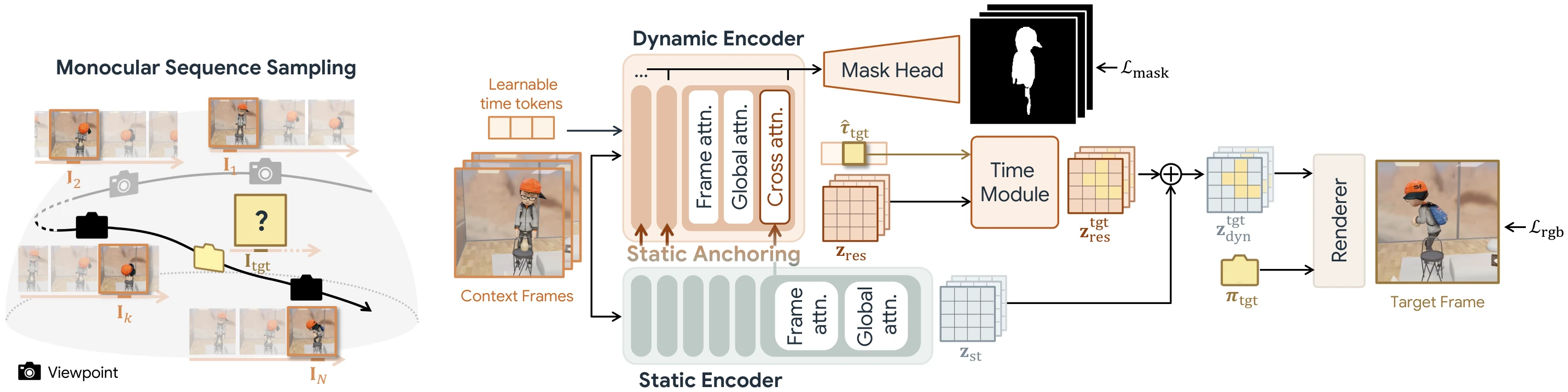
FL4N architecture: a frozen static latent backbone with a lightweight dynamic encoder
arXiv 2026

FL4N: Feed-forward Latent Model for 4D Novel View Synthesis

Eunbeen Hong, Hyeonseo Yu, Honggyu An , Jooho Son, Hyunah Ko, Soowon Son, Chaehyun Kim, Jahyeok Koo, Jisso Kim, Junhwa Hur † , Seungryong Kim †

TL;DR

FL4N synthesizes dynamic scenes at unseen viewpoints and times by combining a frozen static latent backbone with a lightweight dynamic encoder that adds a temporal residual. Training requires only images and binary motion masks.

Overview of Learning Global Motion with Compact Gaussians for Feed-Forward 4D Reconstruction
arXiv 2026

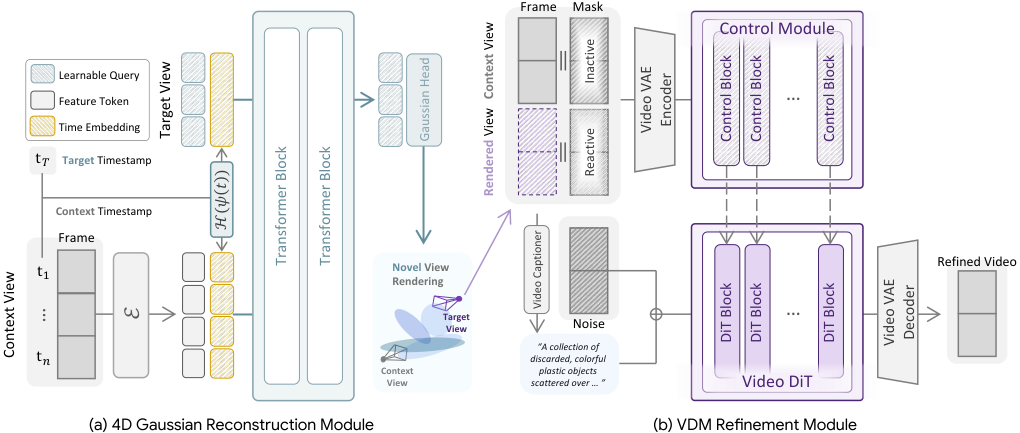
Learning Global Motion with Compact Gaussians for Feed-Forward 4D Reconstruction

Mungyeom Kim * , Minkyeong Jeon * , Honggyu An * , Jaewoo Jung, Hyuna Ko, Jisang Han, Hyunseo Yu, Donghwan Shin, Sunghwan Hong, Takuya Narihira, Kazumi Fukuda, Yuki Mitsufuji † , Seungryong Kim †

Abstract / summary

We propose a feed-forward dynamic reconstruction network that effectively captures the global motion of dynamic scenes. Our method employs a timestamp-conditioned, query-based transformer Gaussian decoder that aggregates geometrically consistent features from multi-frame videos, enabling each Gaussian to model globally coherent motion.

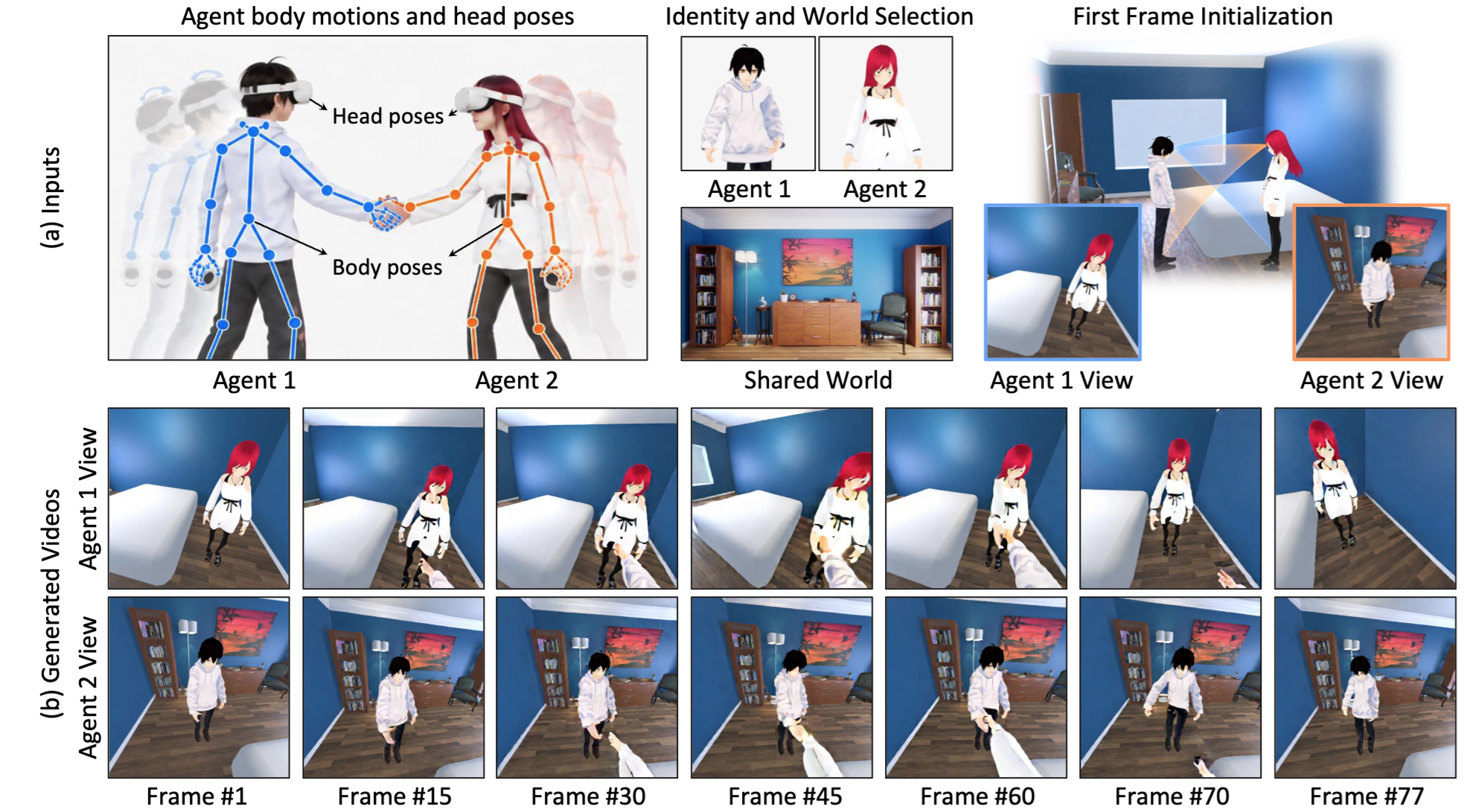
ME-World overview: synchronized egocentric views of interacting agents in a shared world
arXiv 2026

Multi-Agent Egocentric World Model with Fine-Grained Embodied Interaction

Dahyun Chung, Siyoon Jin, Hyunwook Choi, Honggyu An , Wonjin Nam, Junyoung Seo, Hyunsung Kim, Seungwook Kim † , Seungryong Kim †

TL;DR

ME-World generates synchronized ego streams for multiple interacting agents in a shared world. Joint denoising, shared action conditioning, and shared environment memory keep actions, the environment, and interaction outcomes consistent across views.

2025

Overview of Repurposing Video Diffusion Transformers for Robust Point Tracking
arXiv 2025

Repurposing Video Diffusion Transformers for Robust Point Tracking

Soowon Son, Jisu Nam, Chaehyun Kim, Honggyu An , Hyuna Ko, Dahyun Chung, Siyoon Jin, Jung Yi, Jaewon Min, Jiyoung Kim, Junhwa Hur, Seungryong Kim

Abstract / summary

DiTracker repurposes video DiTs for point tracking with softmax-based matching, LoRA adaptation, and cost fusion, achieving stronger robustness and faster convergence

Experience

Sep. – Dec. 2026

Sony Group Corporation

Research Intern · Tokyo, Japan

Mentors: Takuya Narihira, Kazumi Fukuda, and Yuki Mitsufuji

Sep. 2024 – Present

Sony AI

Research Collaboration

Feed-forward 3D/4D reconstruction and compact Gaussian scene representations.

Jan. 2022 – Feb. 2024

Computer Vision Lab, Korea University

Undergraduate Research Intern

Advisor: Seungryong Kim

Education

Sep. 2024 – Present

KAIST

Integrated M.S./Ph.D. in Computer Science and Engineering

Advisor: Seungryong Kim

Mar. – Aug. 2024

Korea University

M.S. in Computer Science and Engineering

Advisor: Seungryong Kim

Mar. 2020 – Feb. 2024

Korea University

B.S. in Computer Science and Engineering